Guides · St. George Island, Florida
The History of St. George Island in 6 Landmarks
It takes a certain kind of place to keep a lighthouse alive for nearly two centuries, but then again, St. George Island has always had to work for its permanence.
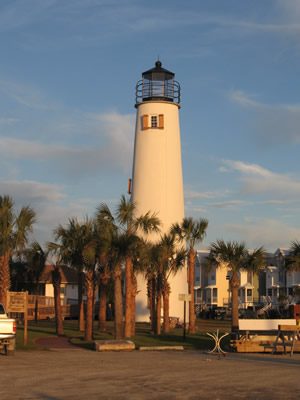
The Cape St. George Light
The island’s story begins at the western tip, where the cape that gives the island its name has spent almost two hundred years trying to hold onto a lighthouse. The first light went up in 1833. It was rebuilt two miles away in 1847-48 after the sea encroached, then rebuilt again following an 1851 hurricane. The structure kept at it until 1994, when it was decommissioned. Then, in 2005, the foundation gave way entirely and the tower collapsed.
Here is the part that tells you everything about this island: they reconstructed it anyway. The light still stands today, a stubborn white sentinel that has outlasted storms, erosion, and even its own ruin. It is not the original location, and it is not the original construction, but it is the same idea. That counts for something on a barrier island.
The Bridge to Eastpoint
For most of its history, the island was a ferry ride away. That was the rhythm of life here—boat schedules, weather windows, the daily negotiation with Apalachicola Bay. Then came the four-mile St. George Island Bridge to Eastpoint, completed in the mid-1960s. It changed everything.
The bridge did not just connect roads. It connected the island to the mainland economy, to Franklin County’s schools and hospitals, to the seafood houses of Apalachicola Bay. Oysters above all—alongside scallops, grouper, flounder, redfish, snapper, trout, and mullet—had always moved by water. Now people could move by asphalt. The ferry became a memory, and the island became a place you could reach on a whim.
Dr. Julian G. Bruce St. George Island State Park
The eastern end of the island is a different world. In 1973, the state purchased 1,800 acres there, and the result is the park that now bears Dr. Julian G. Bruce’s name. It is a place of uninterrupted dunes, tidal flats, and the kind of quiet that makes you check your phone to see if it still works.
The beach here does not need our endorsement, but we will give it anyway: Dr. Beach ranked it number one in the United States in 2023. Forbes had it third in 2013. The ranking is real, and it is also beside the point. What matters is that the park exists as a buffer between development and the Gulf, a stretch of wild that the island never paved over.
The Island’s Permanent Population
Here is the census math, and it is revealing. The island has 1,818 total housing units, but only 1,218 people. It has 1,246 vacant housing units, and 534 homes held for seasonal or recreational use. The median age is 60.9 years. The unemployment rate is 0 percent, and the median household income sits at $96,250.
What does that tell you? This is not a working town in the traditional sense. It is a place people come to rest, to retire, to wait out the seasons. The median home value is $628,500, and 60.6 percent of residents hold a bachelor’s degree or higher. The island is not struggling. It is just quiet. The vacancy numbers are not abandonment; they are absence by design.
The Chili Cook-Off
The social calendar here runs on a few reliable beats, and the biggest is the St. George Island Chili Cook-Off. It started over forty years ago as a small fundraiser for the island’s volunteer fire department. The proceeds still go to local emergency services, which keeps the whole thing grounded in something real.
It has grown since then. The cook-off is now an International Chili Society competition, drawing cooks from across the country. There is a silent auction, and there is the Red Pepper 5K, which gives the runners something to do before the serious eating begins. It is the one weekend a year when the island’s seasonal and permanent populations overlap in the same field, and the whole thing still answers to the fire department.
The Shape of the Place
The landmarks here are not monuments. They are functions. The lighthouse warns, the bridge connects, the park preserves, the census counts, the cook-off feeds. St. George Island has never needed a downtown or a main street to hold itself together. It has a beach that ranks among the best in the country, a bay full of working seafood, and a population that mostly shows up when it wants to.
That is the history of the island in six parts: a light that keeps falling down and getting rebuilt, a bridge that ended the ferry era, a park that kept the wild intact, a census that shows who actually lives here, a chili cook-off that still pays for the fire trucks, and the quiet that holds it all together. It is not a complicated story. It is just a persistent one.
Every business named above is one we hold a listing for, and every date traces to a source on our sources page. We do not describe menus, interiors or service we have not verified. Details change — confirm before you travel.