Guides · St. George Island, Florida
Living in St. George Island, FL: What to Know
St. George Island’s year-round life is measured not by crowds but by tides, the state park’s empty dunes, and a housing market where seasonal vacancy outnumbers permanent residents by more than two to one.
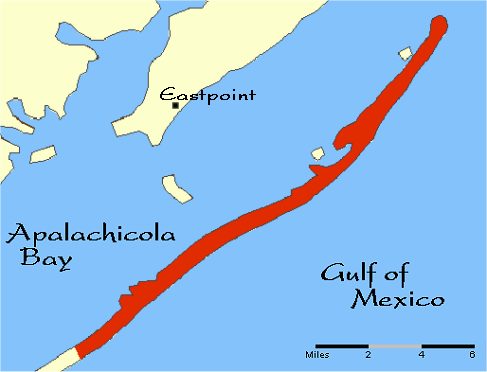
The Bridge That Opened the Island
For more than a century, the only way to reach St. George Island was by ferry. That ended in the mid-1960s, when the four-mile St. George Island Bridge to Eastpoint opened the island to automobiles and, soon after, development. The crossing replaced a daily inconvenience with a permanent connection, and the island began its slow transition from a remote outpost to a residential destination. The bridge remains the single thread tying the island’s past to its present—before it, the land was reachable only by water; after it, the lots filled in.
Population and Housing: The Data
The census figures for St. George Island tell a story that no brochure does. The year-round population is 1,218 people, with a median age of 60.9 years. That small permanent base is dwarfed by the housing stock: 1,815 total units, of which 1,246 are vacant. Of the occupied homes, 534 are held for seasonal or recreational use. The median home value sits at $628,500, and the median household income is $96,250. Unemployment is at 0 percent. This is not a place where people come to find work; it is a place where people come to be done with it.
| Measure | Value |
|---|---|
| Population | 1,218 |
| Median age | 60.9 years |
| Total housing units | 1,815 |
| Vacant housing units | 1,246 |
| Seasonal/recreational homes | 534 |
| Median home value | $628,500 |
| Median household income | $96,250 |
| Unemployment rate | 0% |
| Bachelor’s degree or higher | 60.6% |
The Beach: Top-Ranked but Undeveloped
The beach at Dr. Julian G. Bruce St. George Island State Park was rated number one in the United States by Dr. Beach in 2023, and Forbes had placed it third a decade earlier. The rankings are real, but the experience is the opposite of a resort beach. The park occupies the island’s eastern end, born from a 1,800-acre state purchase in 1973, and it remains largely undeveloped—miles of sand, dunes, and tidal flats without the boardwalk-and-tiki-bar apparatus found elsewhere in Florida. The western end of the island holds most of the homes and amenities; the eastern end holds the wild. That split is the island’s character in miniature: development stops, and the beach takes over.
The Cape St. George Light's Long History
The Cape St. George Light is the island’s most persistent symbol, and its history is one of repeated destruction and stubborn rebuilding. First built in 1833 at the cape on the island’s western end, it was rebuilt two miles away in 1847–48 after the original was lost. An 1851 hurricane took that one down, and it was rebuilt again. The light was decommissioned in 1994, and in 2005 its foundation collapsed entirely. It was reconstructed once more. The lighthouse has now stood, fallen, and risen more times than any structure on the island has a right to, and its presence anchors the island’s sense of itself: things here get knocked down, and they get put back up.
The Bay Economy: Seafood and Apalachicola
The island’s western shore faces Apalachicola Bay, and the water has always been the economy. The bay’s seafood—oysters above all, alongside scallops, grouper, flounder, redfish, snapper, trout, and mullet—feeds the local tables and the nearby town of Apalachicola, nine miles away, which serves as the commercial hub. The bay is not a backdrop; it is a working body of water. That relationship shapes what locals eat, what visitors buy at the docks, and why the annual Florida Seafood Festival in Apalachicola draws crowds each fall. The island itself is residential, not industrial, but its identity is inseparable from the bay that bounds it.
Seasonal Rhythms and the Chili Cook-Off
With 1,246 vacant homes, the island’s population shifts dramatically by season. Winter and summer bring the rental crowds and the second-home owners; spring and fall, the place can feel nearly empty. The off-season quiet is real, and services thin out accordingly. The one event that pulls the community together in that slower stretch is the St. George Island Chili Cook-Off, started over forty years ago as a small fundraiser for the island’s volunteer fire department. The proceeds still go to local emergency services, but the event has grown into an International Chili Society competition with cooks from across the country, a silent auction, and the Red Pepper 5K. It is the island’s anchor in the off-season, a reminder that the permanent residents are still here even when the rental calendar is blank.
The island’s history—the ferry years, the bridge, the lighthouse’s collapses—has produced a place that does not pretend to be anything other than what it is: a narrow strip of sand where the beach is world-class and the year-round population fits in a small town hall. The housing market rewards those who can afford the median $628,500 price tag, and the unemployment rate of zero suggests that those who do live here are not looking for jobs—they are looking for quiet. The beach delivers it, the bay provides it, and the lighthouse keeps watch over it all, as it has, on and off, since 1833.
Common questions
- How do you get to St. George Island?
- Until 1960, the island was reachable only by ferry. The four-mile St. George Island Bridge to Eastpoint was completed in the mid-1960s, so you drive over now. It's about 9 miles from Apalachicola.
- What is the beach like at St. George Island?
- Dr. Beach rated the beach at Dr. Julian G. Bruce St. George Island State Park number one in the United States in 2023. The park sits on the eastern end, created from an 1,800-acre state purchase in 1973. Expect wide, quiet sand.
- Is St. George Island crowded or busy?
- Not really. The year-round population is just 1,218 people, with a median age of 60.9. Most housing units—1,246 of 1,815—are vacant, and 534 are for seasonal or recreational use. So it's quiet outside peak times.
- What is the Cape St. George Light?
- It's the island's historic lighthouse, first built in 1833 at the cape on the western end. It was rebuilt twice—in 1847-48 and after an 1851 hurricane—then decommissioned in 1994. After its foundation collapsed in 2005, it was reconstructed.
- What seafood can I eat here?
- Apalachicola Bay seafood is the draw—oysters above all, plus scallops, grouper, flounder, redfish, snapper, trout, and mullet. It's a working bay, so the catch is local and fresh. Check with local restaurants for the day's haul.
- What events happen on the island?
- The big one is the St. George Island Chili Cook-Off, an International Chili Society competition that started over forty years ago as a fundraiser for the volunteer fire department. Proceeds still go to local emergency services. It also has a silent auction and the Red Pepper 5K.
Every business named above is one we hold a listing for, and every date traces to a source on our sources page. We do not describe menus, interiors or service we have not verified. Details change — confirm before you travel.